
Buddhist Funerals Comprehensive Guide
Buddhist Funerals in Singapore: A Practical Guide to Rites and Planning
From the first steps after a death to the wake, chanting, cremation and memorial prayers.
Buddhist funerals in Singapore at a glance
A Buddhist funeral in Singapore gives family and friends time to honour someone who has died, offer support to one another and, where the family wishes, take part in chanting, prayers and acts of remembrance. A typical arrangement may include care of the deceased, a wake with an altar and visits from relatives, a final ceremony, cremation or burial, and later memorial observances. There is no single ceremony that every Buddhist family must follow. Practices vary between families and Buddhist traditions, and depend on the deceased's wishes, the monk or temple involved, and practical choices such as venue and wake length. Wake length, chanting and memorial observances such as a 49th-day prayer are not compulsory for every family.
If you have just experienced a death, start with the official guidance on death registration and the digital death certificate. You can then discuss the family's wishes with a funeral director and, if relevant, a monk or temple. This Buddhist funeral guide explains the decisions in the order most families face them. For arrangements and help from our team, see our Buddhist funeral services in Singapore.
What happens at a Buddhist funeral?
Buddhist teachings about impermanence and compassion can shape the way a family approaches loss. For some families, chanting and dedicating merit are central. Others place greater emphasis on a quiet farewell, time together and remembering how the person lived. Beliefs and ritual details differ among Buddhist communities, so ask your family's religious adviser which prayers and customs fit your tradition.
A funeral in Singapore may also reflect Chinese family customs alongside Buddhist practice. For example, preferences about mourning clothes, paper offerings or the appearance of an altar can come from family tradition and need not be a requirement of Buddhist teaching. See our guide to Chinese funeral customs for common family practices. Singapore's Buddhist community is largely Mahayana, the tradition most associated with Chinese Buddhism, though Theravada and other traditions are also practised here. The prayers, robes and language used can differ between traditions and even between temples within the same tradition, so ask your family's monk or temple which practice applies rather than assuming one form of Buddhism speaks for all. If relatives have different expectations, it helps to identify which elements mattered to the deceased, which matter to the family now, and which are optional.
| Stage | What the family may arrange | Decision to make |
|---|---|---|
| After the death | Medical certification, digital death certificate and help with the next steps | Who will be the main family contact? |
| Before the wake | Care and dressing of the deceased, choice of coffin, venue and altar | Is there a viewing? What did the deceased request? |
| During the wake | Visits, condolences, remembrance, chanting or prayers if requested | How many days and which rituals are meaningful? |
| Final day | Farewell, transport and cremation or burial | Who will attend and who will handle arrangements afterward? |
| After the funeral | Ash arrangements, family remembrance and any memorial prayers | Does the family want a 49th-day or another observance? |
This is a planning sequence, not a compulsory ritual timetable. For the full sequence of rites and memorial dates, read our Buddhist funeral timeline.

First steps when someone dies in Singapore
If the person dies in a hospital or care setting, the staff can explain how medical certification is handled. For a death at home, arrange for a doctor to certify the death, and follow the authorities' instructions if certification cannot be made. According to Singapore's Immigration & Checkpoints Authority (ICA), a death is automatically registered after a doctor certifies it online. The death certificate is issued digitally, and the next of kin can retrieve it through MyLegacy@LifeSG. Read the current instructions for retrieval and what to do if you cannot access it.
Tell the funeral director where the person is, the family's preferred contact number, any known wishes about religious rites and whether the family is considering a wake. A director can explain collection and care, possible venues, the sequence of the ceremony and the relevant bookings. The National Environment Agency's guide to arranging a funeral explains the official burial and cremation arrangements. For a step-by-step list of what to do at home, read what to do when someone passes on.
If the family asks for a period of quiet prayer before the body is moved, raise this immediately with the doctor or institution and the funeral director. Some Buddhist families request this, but there is no universal eight-hour rule, and medical, legal and care requirements still apply.
Choosing the wake: place, length and atmosphere
The wake is a space for relatives and friends to pay respects and offer condolences. Depending on availability and permissions, a family may ask about a funeral parlour, an approved community venue or another suitable location. Ask who will arrange the venue and whether the quoted package includes its rental, setup and any additional days.
Some families choose a three-day wake, and others want more time for relatives to travel or prefer a simpler farewell. By custom, wakes are often held for an odd number of days, but this is a tradition rather than a fixed rule. A direct cremation is also an option for a family that does not want a conventional wake, and a 1-day wake sits between the two. The right duration follows the family's wishes and circumstances, and a longer wake is not automatically a more respectful one. If a wake will run beyond 7 days after the death, NEA requires prior written permission.
Before confirming the plan, decide whether there will be an open or closed coffin, a portrait, flowers, seating for visitors and space for chanting. Discuss clothing and preparation of the deceased with the funeral director, including any wishes the person left behind. Requirements for body care and viewing depend on the circumstances, so ask what is needed and what each item costs rather than assuming it is part of every funeral.
Chanting, monks and other Buddhist rites
A family may invite a monk or other appropriate religious leader to lead chanting at the wake or on the final day. Some relatives may chant together, listen quietly, offer incense or make a dedication in memory of the deceased. The prayers used, the number and timing of sessions, and the role of family members depend on the community and religious leader.
There is no fixed number of monks that makes a farewell more meaningful. Ask the monk or temple what is appropriate for your family's tradition, and ask the funeral director to distinguish the religious leader's fees or donations from the funeral package price.
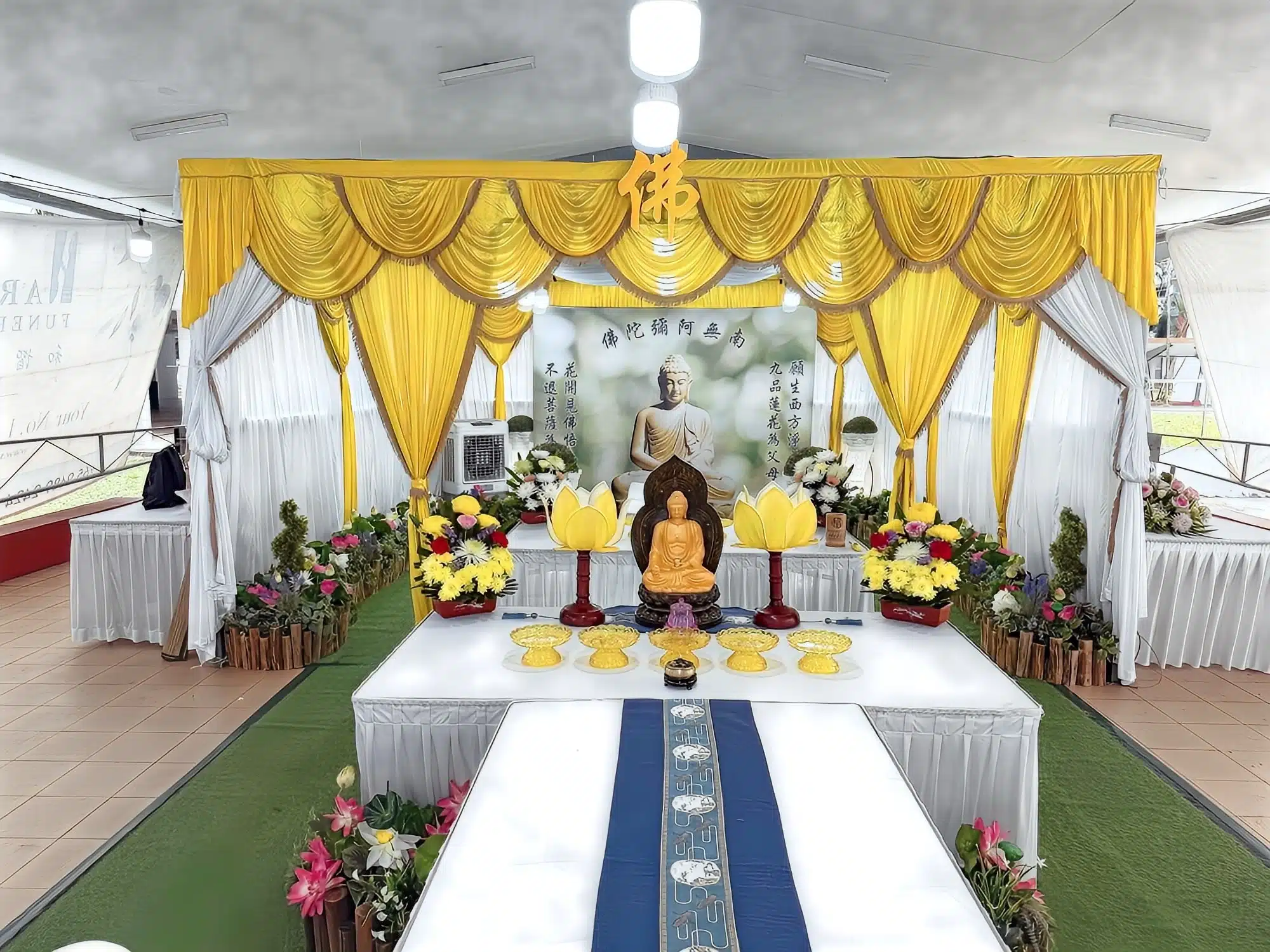
An altar may include the deceased's portrait, flowers and other items selected with the family and religious adviser. Families can also incorporate a eulogy, photographs or a short remembrance. These moments make room for visitors who did not know the prayers but want to honour the person.
Are paper offerings part of a Buddhist funeral?
Practices vary. Some families prefer flowers, incense, chanting and charitable acts, and others include paper offerings as part of inherited Chinese family custom. Ask the monk or temple about any religious guidance and check the venue's rules before deciding. The funeral director should explain what is included, optional and permitted. For a fuller comparison, see the differences between Buddhist and Taoist funerals.
The final day and arrangements after cremation or burial
On the final day, the family may hold a farewell or chanting session before leaving the wake venue. The funeral director coordinates transport and the confirmed cremation or burial booking. The sequence can be adjusted to the family's rites and the facility's arrangements.
Cremation is more commonly chosen in Singapore, but burial remains an option where a family prefers it and space is available. According to MyLegacy@LifeSG, a burial plot in Singapore is granted for a lease of 15 years, after which the grave may need to be exhumed; the family can then choose to cremate the exhumed remains. Ask the funeral director early if burial is being considered, since cemetery space and booking timelines differ from cremation.
After cremation, families may consider a columbarium niche, keeping ashes at home where appropriate, or an authorised ash-scattering arrangement. The NEA guidance on burial, cremation and ash storage sets out the available options and current application requirements. Decide who in the family will be the applicant and where the relevant documents will be kept.
Some Buddhist families arrange a 49th-day prayer or other remembrance, and others have different observances or none. Discuss the dates and meaning with the monk or temple instead of assuming every family needs the same schedule. You can read about the 49 days after a Buddhist funeral for one common tradition. There may also be a family gathering or an anniversary remembrance. A memorial can be simple: visiting a place connected with the person, sharing a meal or making a donation in their memory.
How families adapt Buddhist funerals today

In our work with families, we see different ways of honouring the same underlying wishes. One family may need several days for overseas relatives to arrive, and another may prefer a short wake and private cremation. Some choose restrained flowers and a small altar, and others include a larger gathering and more formal chanting. These are choices available to a family, not evidence that one form of Buddhist funeral is replacing another.
| If the family is considering… | Ask yourselves… |
|---|---|
| A shorter wake or direct cremation | Who needs time to visit, and will there be another gathering afterward? |
| One chanting session or several | What does our monk or temple recommend, and what did the deceased value? |
| Simple dress or formal mourning attire | Is there a family custom we want to observe or explain to guests? |
| A modest setup or more elaborate décor | Which items help us remember the person, and which can we leave out? |
| A traditional vigil or a quieter evening | Who can realistically be present, and what support does the family need? |
A good plan gives the family enough time to say goodbye without making them feel they must purchase a ritual or item whose purpose they do not understand.
What we commonly see when arranging Buddhist funerals in Singapore
In our experience arranging Buddhist funerals in Singapore, the first disagreement is rarely about whether the family wants to honour the deceased. It is usually about which customs come from Buddhist teachings, which are inherited Chinese family practices and which are personal preferences.
We therefore begin by asking three questions:
- What did the deceased believe or request?
- Which practices matter most to the immediate family?
- Has a monk or temple given the family specific guidance?
Families often ask whether they must arrange a particular number of chanting sessions, monks or wake days. There is no single answer for every family. The appropriate arrangement depends on the family’s tradition, the monk’s guidance and the kind of farewell the deceased wanted.
We also meet families who want Buddhist chanting while retaining selected Chinese customs. Rather than labelling the entire arrangement as strictly Buddhist or Taoist, we explain the purpose and cost of each element so the family can make an informed decision.
A shorter wake is not less respectful, and a more elaborate setup is not automatically more meaningful. What matters is that the family understands its choices and can honour the deceased without feeling pressured to include customs it does not understand.
— Harmony Tee, Founder and Funeral Director of Harmony Funeral Care
Questions to ask before confirming a funeral arrangement
How to choose a funeral service provider: the CARE framework
Families comparing providers often end up asking the same few questions. Harmony Funeral Care groups these into four criteria we call the CARE framework: Compassionate guidance, Authentic and meaningful farewell, Reliability and transparency, and End-to-end support. Use it as a starting point when you compare providers, not as a checklist any single company can claim to satisfy without you verifying it yourself.
| Letter | Stands for | What to look for |
|---|---|---|
| C | Compassionate guidance | Staff who listen, explain options patiently and do not pressure the family into decisions while grieving. |
| A | Authentic and meaningful farewell | Rites, tributes and details that genuinely reflect the deceased's beliefs and the family's wishes, not a one-size-fits-all package. |
| R | Reliability and transparency | Clear, itemised pricing agreed in writing before you commit, with no surprise charges added later. |
| E | End-to-end support | Help that continues beyond funeral day, such as guidance on memorial dates or bereavement resources. |
Ask for an itemised written quotation and a clear schedule. These questions help compare arrangements:
- What does the base price include for collection, care, coffin, transport, venue setup and staff?
- Are venue rental, extra wake days, meals, flowers, religious arrangements and cremation or burial fees separate?
- Who will contact the monk or temple, and can the family use its own religious adviser?
- What changes if we choose a closed coffin, a short wake or direct cremation?
- Who will handle the documents and bookings, and which decisions must the family make itself?
- What happens after the final ceremony, including collection and placement of ashes?
- Who can we contact throughout the wake if the family needs a change?
For help comparing what may be included in a quoted arrangement, read our Buddhist funeral package cost guide. Confirm the current quotation and optional charges directly before making a decision.
Frequently asked questions about Buddhist funerals in Singapore
How many days does a Buddhist funeral take in Singapore?
There is no fixed number for all Buddhist funerals. Families choose a wake length according to the deceased's wishes, visitors' needs, venue availability and religious advice. By custom, wakes are often held for an odd number of days, but this is a tradition rather than a fixed rule. A short wake or direct cremation can also be considered.
Must a Buddhist funeral have chanting or a monk?
Many families choose chanting led by a monk, but the ceremonies vary by tradition and preference. Speak to your family's temple or religious adviser about what is appropriate.
Is cremation required for a Buddhist funeral?
No single arrangement suits every Buddhist family. Discuss the deceased's wishes and your tradition, then check available burial or cremation arrangements against the current NEA guidance.
Is a 49th-day prayer compulsory?
No. Some families observe it, while others follow different memorial customs. Ask your monk or temple if your family wants guidance on timing or prayers. Read more about the 49 days after a Buddhist funeral.
What should I do if family members disagree about the rites?
Begin with any wishes the deceased expressed. Ask each person which customs matter most, invite the monk or temple to clarify religious questions, and have the funeral director explain the practical and cost implications of each choice.
What is the difference between cremation and burial in Singapore?
Cremation is more commonly chosen in Singapore, but burial is available where a family prefers it. A burial plot is granted for a lease of 15 years, according to MyLegacy@LifeSG, after which the grave may need to be exhumed. Ask your funeral director about cemetery availability and booking timelines if burial is being considered.
How soon must a Buddhist funeral be arranged?
There is no single fixed timeframe. Arranging a funeral director typically takes a minimum of about 3 hours, depending on the case, the venue's availability and the family's decisions about the wake. Contact a funeral director as soon as possible so they can explain the realistic timeline for your situation.
Related guides
Official sources referenced
- Immigration & Checkpoints Authority: Death registration
- MyLegacy@LifeSG: Download a death certificate
- National Environment Agency: Arranging a funeral
- National Environment Agency: Burial, cremation and ash storage
- MyLegacy@LifeSG: Manage the burial
Religious practice differs between families and communities. Confirm tradition-specific rites with your monk, temple or family elders. Procedures and fees set by government agencies can change, so check the official pages above.
Need help arranging a Buddhist funeral?
Harmony Funeral Care can walk your family through the available arrangements, the proposed schedule and an itemised quotation. Contact us to discuss the person's wishes and the next steps, or see our Buddhist funeral services.
24-hour telephone assistance and collection services are available. Office visits are by appointment.
 WhatsApp us