

Buddhist Funeral Timeline in Singapore: From Death to Memorial Rites
What happens, and when: from the day of death and the wake, to cremation, the 49th day, the 100th day and the anniversaries.
A Buddhist funeral in Singapore usually follows this order: arrangements on the day of death, a wake of 1, 3, 5 or 7 days with monk chanting, the funeral day and cremation, then the collection of ashes. Many Chinese Buddhist families continue with memorial prayers every seven days up to the 49th day, and some also mark the 100th day and the first and third anniversaries.
The exact sequence varies by family, temple and Buddhist tradition. Only the legal steps, such as certifying the death and getting the cremation permit, are fixed. The rest are customs your family can choose to follow.
Buddhist funeral timeline at a glance
- Before deathPlanning aheadOptional. Talk about wishes, the temple or monk, the venue and the package.
- Day 0Death and first arrangementsThe doctor certifies the death; we collect your loved one and plan the wake with you.
- Wake day 1The wake beginsEncoffining, altar setup and the first chanting session.
- Middle daysCondolencesRelatives and friends pay their respects; extra chanting if arranged.
- Final eveningFinal-night chantingThe main night of the wake, and a briefing for the funeral day.
- Funeral dayFinal prayers and cremationMonks chant before departure, then the procession to the crematorium or cemetery.
- After cremationAsh collectionThe ashes are placed in a niche, kept at home or scattered.
- Day 7 to 49Seven-week memorial prayersPrayers every seven days, ending on the 49th day, where observed.
- Day 100100th-day remembranceA custom of some Chinese families.
- Year 1 and 3Anniversary prayersSuch as 超度 (Chao Du) rites, if the family wishes.
An illustrative timeline only. Your dates depend on your family's tradition, your monk or temple, and the cremation slot.
| Stage | Approximate timing | What happens | Who is involved | Family decides |
|---|---|---|---|---|
| Before death | Weeks or months before, if possible | Planning wishes and arrangements | Family, funeral director | Temple or monk, venue, package |
| Day of death | Day 0 | Certification, collection, planning | Doctor, family, funeral director | Venue, wake length, cremation or burial |
| Wake setup | Day of death or the next day | Encoffining, altar, portrait | Funeral director, monks | Photo for the portrait, clothes |
| First chanting | First day of the wake | Monks chant for the deceased | Monks, family | Number of monks |
| Middle of wake | Days between | Visitors, offerings, optional chanting | Family, guests | Extra sessions, food |
| Final evening | Night before the funeral | Final-night chanting, briefing | Monks, family, funeral director | Pallbearers, who travels with the hearse |
| Funeral day | Last day of the wake | Final prayers, procession, cremation | Monks, family, funeral director | Route, final farewell |
| Ash collection | After cremation | Ashes collected and placed | Family, funeral director | Niche, scattering or home |
| Seventh days | Every 7 days from death | Memorial prayers (where observed) | Family, temple | Which weeks to observe |
| 49th day | 7 weeks after death | Final seven-day prayers | Family, temple | Whether to hold prayers |
| 100th day | About 100 days after death | Remembrance (some Chinese families) | Family | Whether to observe |
| 1st anniversary | 1 year after death | Anniversary prayers | Family, temple | Whether to hold prayers |
| 3rd anniversary | 3 years after death | End of the traditional mourning period | Family, temple | Whether to hold prayers |
Buddhist teaching and Chinese custom
Buddhist funerals in Singapore often combine Buddhist teaching with Chinese family customs, and sometimes Taoist influences. Chanting, merit-making and reflection on impermanence come from Buddhism. Practices such as burning paper offerings or believing the deceased returns home on a certain night come from Chinese folk tradition, and not every Buddhist family follows them. Theravada families, for example, often hold a merit-making offering (dana) on the seventh day rather than the full seven-week cycle.
Before death: planning a Buddhist funeral
Do not be caught off guard when death happens. If a loved one is seriously ill, planning a few weeks or months ahead means fewer decisions under stress. Three months is just an example; any time is helpful. Things to talk about include:
- Religious wishes, and a preferred temple or monk
- Wake venue: HDB void deck, funeral parlour or home
- How many days the wake should be
- Cremation or burial, and where the ashes will go
- Who in the family will make decisions
See our guide to funeral pre-planning.
Day 0: what happens when someone dies?
- The death is certified. A doctor certifies the death. It is then registered automatically with ICA, and the next of kin can download the digital death certificate from LifeSG, free, within 30 days.
- Call a funeral director. We collect your loved one once the death is certified, or once they are released by the hospital or the Mortuary @ HSA.
- Plan the funeral. We sit down with the family to agree on the venue, the wake length, the monks and the cremation date. We also apply for the Permit to Cremate and book the cremation slot.
Families with a death at home can read what to do when someone passes away. Take time to grieve; we handle the arrangements from collecting your loved one through to the end.
Day 1: setting up the Buddhist funeral wake
The wake may start on the day of death, or the next day if the death happens late in the evening. On the first day:
- The venue is set up with the coffin, the Buddhist altar and the funeral portrait.
- Your loved one is placed in the coffin. The encoffining is often led by one, three or five monks.
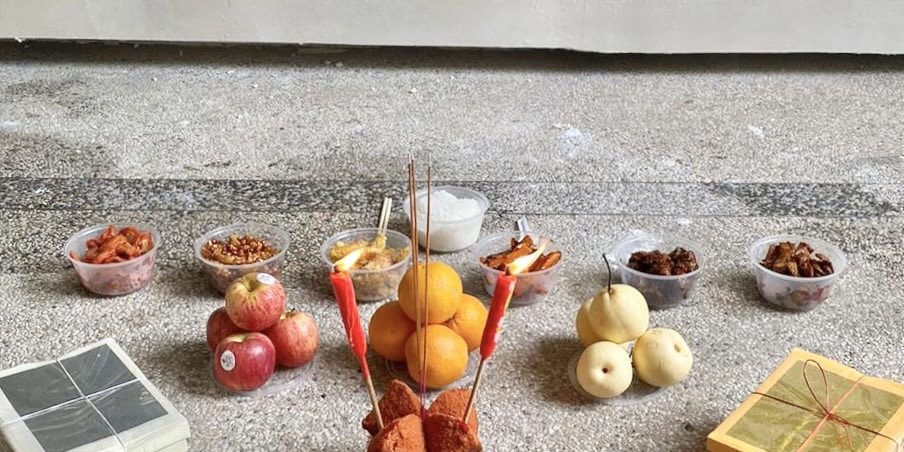
- Vegetarian food and fruit are offered, usually on two altars: one for the Buddha and one for the deceased.
- We brief the family on what to expect during the wake.
- The first chanting session takes place, and relatives begin to visit.
Middle of the wake: condolences, chanting and offerings
Relatives, friends and colleagues come to pay their respects, often by offering incense and a short bow. The family receives guests and keeps watch with the deceased.
Some families arrange extra chanting sessions, or have their temple's volunteers chant. Offerings are refreshed each day. Paper offerings are a Chinese custom followed by some families, not a Buddhist requirement.
Final evening: chanting and preparing for the funeral day
The night before the funeral is often the main night of the wake, when the most relatives attend. It usually includes:
- The final-night chanting session
- A briefing from us on the funeral-day schedule
- Choosing the pallbearers and who will travel with the hearse
- Confirming transport for the family and the cremation time
Funeral day: final prayers, procession and cremation
- Monks chant the final prayers before departure.
- The family says a final farewell and the coffin is closed.
- Pallbearers carry the coffin to the hearse.
- The procession goes to Mandai Crematorium (or Choa Chu Kang Cemetery for burial). We arrange transport for the family.
- At the crematorium, there may be a short final prayer before the cremation.
The time allowed at the crematorium is limited, so we plan the morning around your cremation slot.
After cremation: ash collection and final resting place
The ashes are collected at the time given by the crematorium. Families then choose where they will rest:
- A niche in a government columbarium or a temple
- Keeping the ashes at home
- Scattering at the Garden of Peace (Choa Chu Kang) or the Garden of Serenity (Mandai)
- Scattering at sea, at the designated area east of Raffles Lighthouse
Days 7 to 49: seven-week memorial prayers
In Chinese Mahayana Buddhist tradition, the 49 days after death are believed to be a time of transition before rebirth. Many families hold prayers every seven days (the 7th, 14th, 21st, 28th, 35th, 42nd and 49th days), dedicating merit to the deceased. Some families observe all seven, while others observe only the first and the last.
The first seventh day
The first seventh day is often the most observed. Some Chinese families believe the deceased returns home around this time; this is a folk belief rather than Buddhist teaching.
The 49th day
The 49th day marks the end of the seven-week period, and many families hold chanting or merit-making at a temple or at home. It is not compulsory. See our guide to 49 days after a Buddhist funeral.
The 100th day after death
Some Chinese families mark the 100th day with prayers or a family gathering. It is a family custom rather than a universal Buddhist requirement. See our guide to 100 days after a Buddhist funeral.
One year and three years after death
Families may continue to remember their loved one for up to three years. Some hold 超度 (Chao Du) prayers for the deceased at the first and third anniversaries, with the third year traditionally marking the end of mourning. These are optional, and we can help arrange them with your monk or temple.
How are Buddhist funeral days counted in Singapore?
By custom, many Chinese families hold wakes for an odd number of days (1, 3, 5 or 7) and count from the date of death, not from the day the wake begins.
If someone passes away late at night and the wake starts the next day, a planned 3-day wake can end up spanning 4 days from the date of death. In our experience, families can hold a short Cheng Guan ritual to account for the extra day so the count lines up again. It can also be used if the wake has to be extended by a day, for example when no cremation slot is available. Ask your funeral director how your dates will be counted.
Good to know: NEA requires prior written permission for a wake that goes beyond 7 days after death.
What Buddhist prayers does Harmony Funeral Care arrange during a wake?
Our Buddhist funeral package includes monk chanting on three main occasions, plus two additional prayer services:
- First day of the wake
- Final night
- Funeral day, before departure
- Sa Qing: a cleansing prayer for the deceased's home
- An Ling: placing the ancestral tablet
This is how our package is arranged, not a fixed Buddhist rule. If your family follows a particular temple or monk, tell us early and we will work with them. See our Buddhist funeral services.
How much do Buddhist funeral and memorial rites cost?
| Arrangement | Starting price |
|---|---|
| Direct cremation, no wake | From S$1,380 nett |
| Wake at a funeral parlour | From S$4,688 nett |
| 3-day wake at an HDB void deck | From S$5,288 nett |
| Each extra wake day | Typically about S$300 to S$500 |
| Prayers after the funeral (7th, 49th day, anniversaries) | Quoted separately |
See the Buddhist funeral package for inclusions and exclusions.
What if the family chooses direct cremation?
With a direct cremation, there is no wake: the timeline goes straight from the day of death to the cremation. Families can still ask monks to chant at the crematorium, and hold the seventh-day, 49th-day and anniversary prayers afterwards.
Frequently asked questions
How long does a Buddhist funeral last in Singapore?
The wake usually lasts 1, 3, 5 or 7 days, with 3 days being common, followed by the funeral day and cremation. Memorial prayers may continue to the 49th day and beyond.
What happens on the first day?
The wake is set up with the coffin, altar and portrait, the encoffining takes place, and monks hold the first chanting session. Relatives start to visit.
When does monk chanting take place?
Commonly on the first day of the wake, the final night and the funeral day before departure. Families can arrange extra sessions.
What happens on the final night?
Monks hold the final-night chanting, and the funeral director briefs the family on the funeral-day schedule, pallbearers and transport.
What happens on cremation day?
Monks chant the final prayers, the family says goodbye, and the coffin is taken in the hearse to Mandai Crematorium for the cremation.
Are Buddhist funerals always three days?
No. Three days is common, but wakes can be 1, 5 or 7 days, or there can be no wake at all with a direct cremation.
How are funeral days counted?
Many Chinese families count from the date of death, not from the day the wake starts, and prefer an odd number of days. A late-night death can add a day; a short Cheng Guan ritual can account for it.
What is the first seventh day?
It is the seventh day after death, when many families hold the first memorial prayers. Some Chinese families believe the deceased returns home around this time, which is a folk belief rather than Buddhist teaching.
Why is the 49th day important?
In Chinese Mahayana Buddhist tradition, the 49 days after death are believed to be a period of transition before rebirth. The 49th day marks the end of that period.
Is the 49th-day prayer compulsory?
No. It is a widely followed custom, but families can choose whether to hold it and how.
What happens on the 100th day?
Some Chinese families hold prayers or a family gathering to remember the deceased. It is a family custom, not a universal Buddhist requirement.
Do families need first-year and third-year prayers?
No. Some families hold Chao Du prayers at the first and third anniversaries, but they are optional.
When are ashes collected?
After the cremation, at the time given by the crematorium. The family or funeral director collects them and places them in a niche, at home or arranges scattering.
Can families choose direct cremation?
Yes. There is no wake, but monks can still chant at the crematorium, and memorial prayers can be held afterwards.
What happens if the funeral is delayed?
If the wake needs an extra day, for example because no cremation slot is available, a Cheng Guan ritual can help keep the traditional day count. A wake beyond 7 days after death needs NEA's prior written permission.
Related guides
Official sources
Religious customs vary. Please confirm details with your monk or temple.
Planning a Buddhist funeral?
Call us at any hour. We will explain each step and arrange the wake, chanting and cremation with you.
 WhatsApp us