

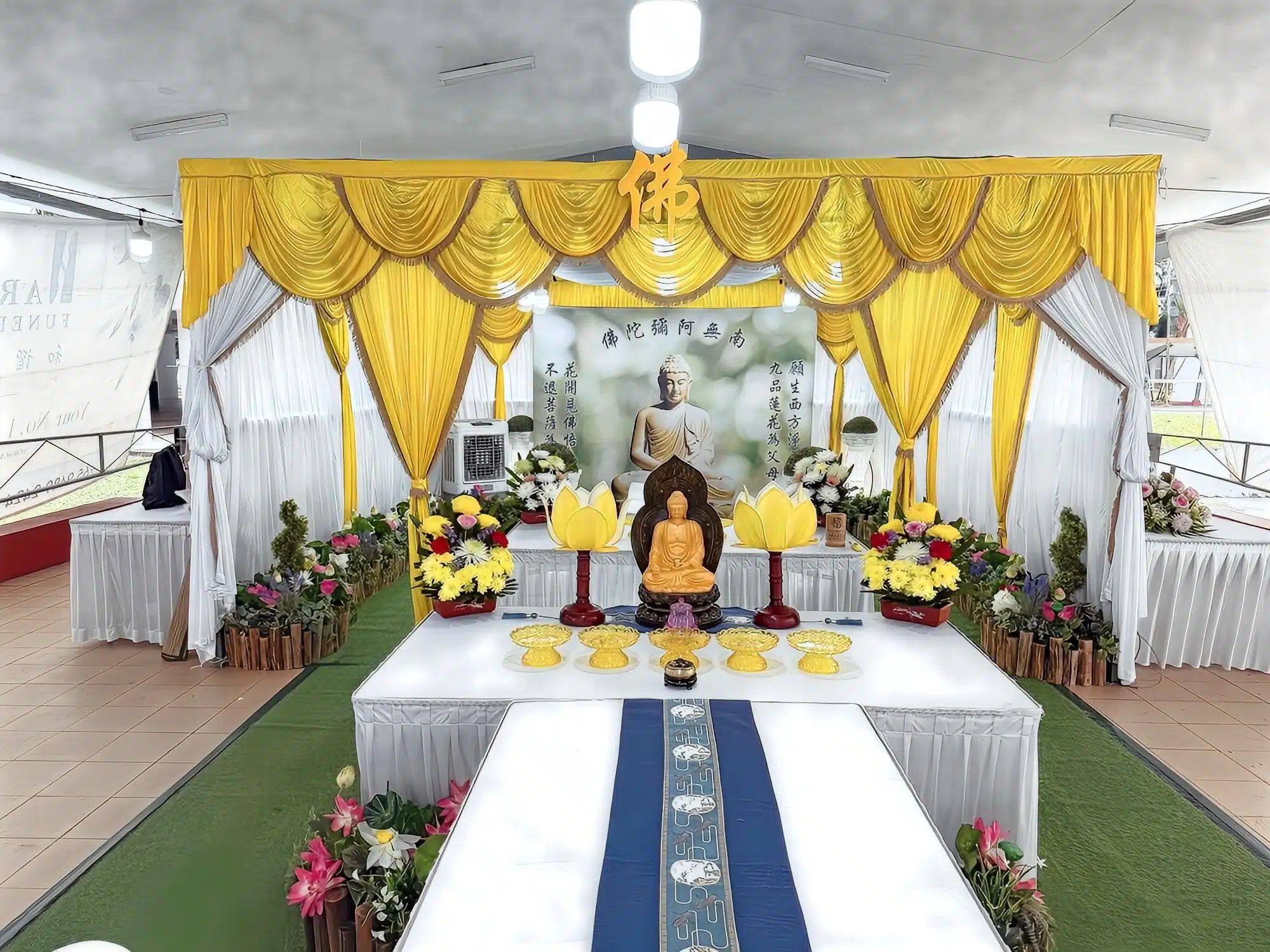
Buddhist Funeral Package Cost and What's Included in Singapore
Clear 2026 prices, a full inclusions list, and what costs extra, so you can compare with confidence.
Wake packages from $4,688 nett·Direct cremation from $1,380·Itemised quotation
Buddhist funeral prices in Singapore vary with the venue, the number of wake days and the extras you choose. This page sets out what Harmony Funeral Care's Buddhist packages cost, what each one includes, what is charged separately, and the questions to ask before you compare quotes. For how a Buddhist funeral is arranged, the rites and the paperwork, read our Buddhist funeral services guide.
This guide is for: families comparing the cost of a Buddhist funeral in Singapore. It covers Harmony Funeral Care's package prices and common additional charges. For rituals, funeral procedures and religious considerations, see our Buddhist funeral services guide.
Buddhist funeral package cost at a glance
A Buddhist funeral package in Singapore costs from $1,380 for direct cremation and from $4,688 nett for a wake at a funeral parlour with Harmony Funeral Care. A 3-day wake at an HDB void deck starts from $5,288 nett. Based on Harmony Funeral Care's own completed Buddhist wake arrangements, families typically spend about $5,288 to $7,000 all-in for a 3-day wake, and up to about $8,000 to $9,000 once extras such as catering, a casket upgrade and additional chanting are added. This is Harmony's own observed range, not an independent industry average.
| Direct cremation (no wake) | From $1,380 |
|---|---|
| Wake at funeral parlour | From $4,688 nett |
| 3-day wake at HDB void deck | From $5,288 nett |
| Typical all-in spend, 3-day wake | About $5,288 to $7,000 |
| With extras | Up to about $8,000 to $9,000 |
| Each extra wake day | About $300 to $500 |
| Consultation | Free and non-obligatory, with a complimentary Funeral Planning Guide |
Rows marked "from" or "nett" are Harmony Funeral Care's published package prices. Rows marked "typical" or "about" reflect Harmony's own completed arrangements, not an independent industry survey. See how these prices were prepared.
How these prices were prepared
Harmony package prices are taken from our current price list, last reviewed on . Government fees are checked against the National Environment Agency (NEA). Figures described as "typical," "about" or "often" reflect Harmony Funeral Care's own completed Buddhist funeral arrangements, not an independent industry survey, and every family still receives a written, itemised quotation confirming the exact price before booking.
How much does a Buddhist funeral package cost in Singapore?
Prices below are nett starting prices. The venue and the number of wake days change the total most, followed by the casket, the number of monk sessions and the extras you add. Your itemised quotation shows the exact scope before you commit.
| Package | From (nett) | Venue and length | Suits families who want |
|---|---|---|---|
| Buddhist direct cremation | $1,380 | No wake and no venue booking | A simple, low-cost arrangement |
| Buddhist wake at funeral parlour | $4,688 | Funeral parlour; length confirmed in your quotation | A wake, monk chanting and a full funeral setup |
| Buddhist 3-day wake at HDB void deck | $5,288 | HDB void deck, 3 days | An essential, balanced wake near home |
| Buddhist 5-day or longer wake | Base price plus about $300 to $500 per extra day | Void deck or parlour, 5 days or more | An extended, traditional wake with more time for visitors |
| Buddhist wake at landed property or home | Quoted on request | Custom tentage; price differs from a void deck setup | The wake held at the family home |
For a 3-day wake at an HDB void deck, families we serve typically spend about $5,288 to $7,000 all-in, based on Harmony's own completed arrangements rather than an industry-wide survey. After extras such as catering, a casket upgrade and additional chanting, the final total is often about $8,000 to $9,000. See what costs extra for the individual prices.
Which Buddhist funeral package should you choose?
Choose direct cremation if you want a simple arrangement without a wake. Choose a 3-day wake for an essential, balanced farewell. Choose a 5-day or longer wake if you want a more extended traditional wake. Neither a 3-day nor a 5-day wake is universally better; it depends on budget, how much time visitors need and how traditional the family wants the wake to feel. We encourage a wake of at least 3 days.
| Consideration | 3-day wake | 5-day wake |
|---|---|---|
| Budget | Lower | Higher, with about $300 to $500 for each extra day |
| Time for visitors | Moderate | More time |
| Traditional feel | Suitable for most families | More extended |
| Logistics | Simpler | More involved |
By custom, a Buddhist wake is usually held for an odd number of days (1, 3, 5 or 7), though this is a tradition rather than a fixed rule. A wake that goes beyond 7 days after the death (a 9-day wake, for example) may need additional approval from NEA or the venue operator; ask us to confirm the current requirement before you plan an unusually long wake. A 1-day wake is also possible, though less common. For venues, permits and the wake timeline, read our guide to Buddhist wake venues.
What is included in a Buddhist funeral package?
Everything you need for a respectful Buddhist farewell, coordinated by our funeral directors from the moment of passing until after the funeral. Exact inclusions can differ between the funeral parlour and void deck options, so confirm them in your quotation.
Collection, Embalming & Encoffining
- Prompt, personal attention 24/7 from your assigned funeral director
- Transfer of your loved one from hospital or home to our in-house embalming care centre
- Professional cleansing, dressing and embalming, with natural make-up
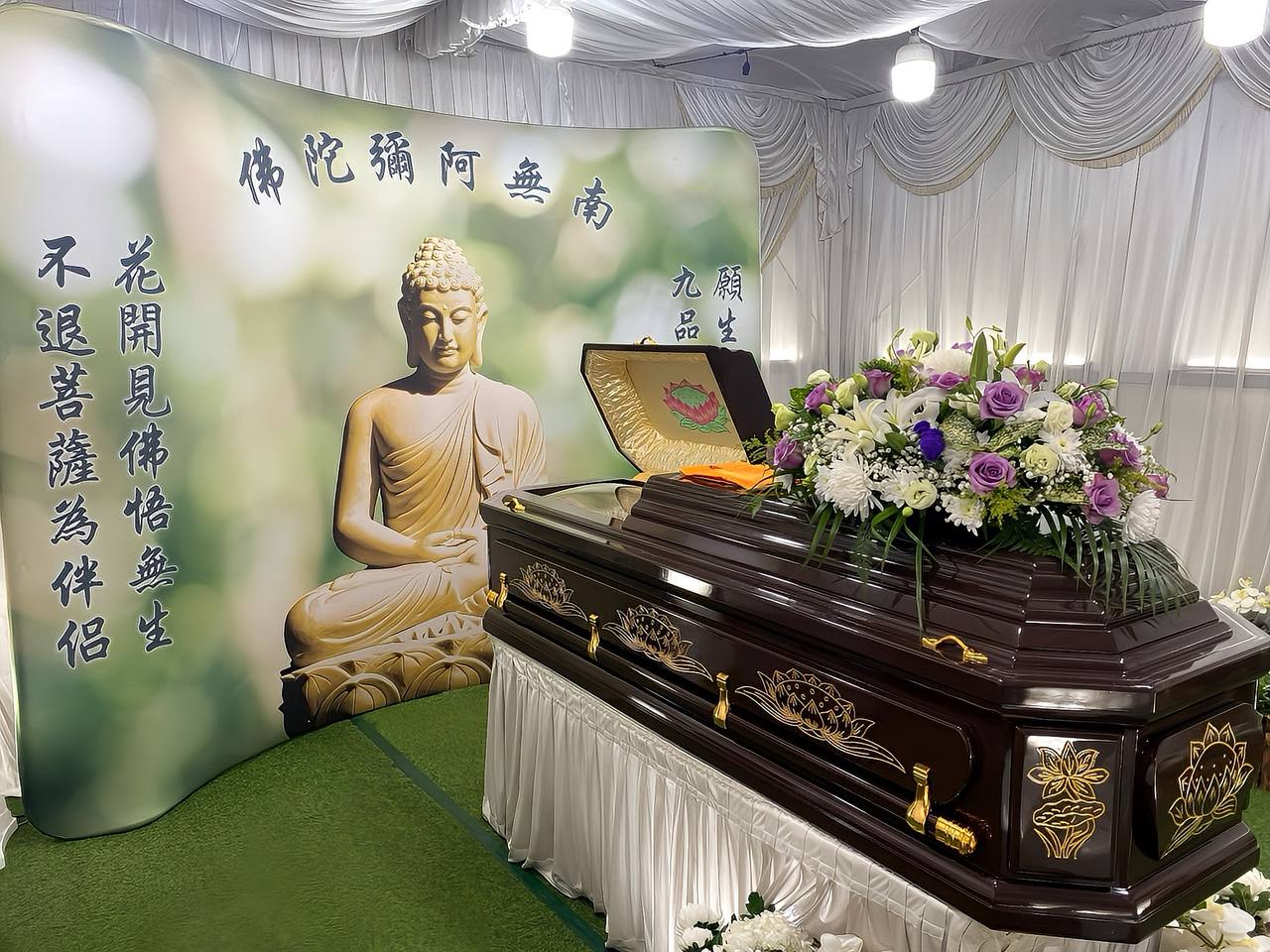
- Imported, well-varnished casket with lining
- Cremation booking
- Step-by-step guidance on Chinese funeral customs
Wake Venue & Setup
- Booking of your funeral venue, including HDB void decks or a funeral parlour
- Void deck setup:
- 3-sided canvas with curtain and fully carpeted flooring for the memorial site
- 10 round tables and 15 square tables, including a reception table
- 100 white chairs
- Air cooler at the coffin area
- General lights and fans
Buddhist Religious & Prayer Services
- Reverend monk chanting on the three main occasions:
- First day of the wake
- Final night
- Funeral day before departure
- Two additional prayer services:
- Sa Qing: house cleansing, with the monk cleansing the deceased's premises
- An Ling: placement of the ancestral tablet
- Food and fruit offerings at the Buddha's altar and for afterlife rituals
Wake Décor & Memorial Items
- Buddhist-styled décor, altar and backdrop
- Floral décor: table-top flowers and a floral wreath for the funeral portrait
- Enlarged memorial funeral portrait in a sturdy wooden frame, plus six passport-sized photographs
- Guest book and condolence money box
- Mini portable speaker
- Funeral memorabilia
- Bilingual funeral announcement (English & Chinese)
Funeral Day Arrangements
- Professional pallbearers dressed in formal suits with blazers
- Experienced emcee to guide the family through the entire procession
- Floral water cleansing setup and guidance
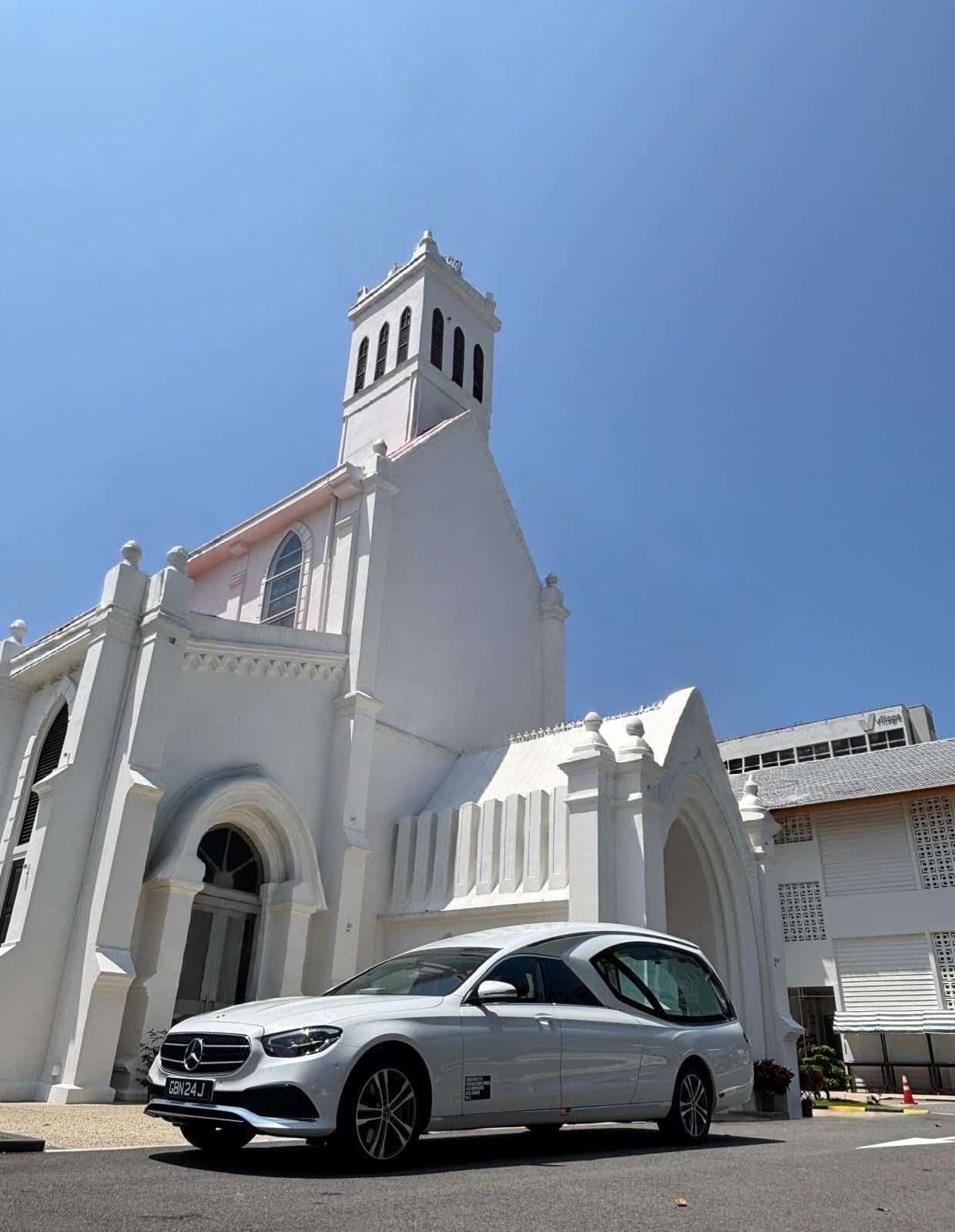
- Glass-panel funeral hearse
- 45-seater air-conditioned coach (return trip)
Complimentary Memorial Keepsake
Included at no additional cost. A memorial photo montage of your loved one, created as a meaningful keepsake.
Post-Funeral Support
- Ash collection service and guidance
- Advice on important Buddhist memorial prayer dates and post-funeral rituals
- Complimentary introductory grief coaching session for immediate family members
Dedicated Family Support
Every family is assigned a minimum of two dedicated funeral directors, so there is always someone available to support you throughout the funeral. Start with a free, non-obligatory consultation.
Confirm in your quotation: the casket model, venue and number of wake days, the number of monks and sessions (these can vary with your family's wishes), and crematorium, burial or ash-storage fees.
Funeral gallery




What is not included in a Buddhist funeral package?
These items are charged separately, either because they depend on your choices or because they are used on request. All of them are listed in your itemised quotation.
| Item | Typical cost | Price basis |
|---|---|---|
| Fridge rental | About $50 per day (typically $40 to $65) | Harmony Funeral Care price |
| Portable toilet rental | About $80 per day | Harmony Funeral Care price |
| Government cremation fee | $100 for an adult, $50 for a child under 10, at Mandai (NEA) | Government fee, set by NEA |
| Tse Tho Aum Temple cremation fee | $432 | Third-party venue fee, not set by Harmony |
| Bright Hill Temple (Kong Meng San Phor Kark See) cremation fee | $327. This crematorium is temporarily unavailable due to redevelopment, expected to resume around early 2029; ask us for the current status before choosing this venue. | Third-party venue fee, not set by Harmony |
| Buffet catering | About $16 per person (30-person minimum) | Harmony Funeral Care service |
| Additional monk chanting | $380 to $480 per session | Harmony Funeral Care price |
| Casket upgrade | $0 to $5,000 or more, depending on the model | Harmony Funeral Care price, confirmed after consultation |
| Government columbarium niche | $500 (standard) or $900 (family), plus $250 to choose the location (NEA) | Government fee, set by NEA |
| Private columbarium niche | About $2,000 to $30,000 or more, depending on the facility and niche type | Third-party venue fee, not set by Harmony |
| Additional photo enlargement or framing | About $150 | Harmony Funeral Care price |
| Live-streaming or videography | About $650 to $850 (4 hours, 2 locations) | Harmony Funeral Care price |
| Tidbits and drinks | Pay as you use, so you only pay for what is used | Harmony Funeral Care price |
| Newspaper obituary and mourning attire | On request, or paid per use. You can also buy your own attire. | Third-party estimate, quoted individually |
Government fees are set by NEA and may change; check NEA's cremation and ash storage page for the latest. Third-party venue fees are set by that venue, not by Harmony Funeral Care, and are confirmed at the time of booking.
Singapore Buddhist Funeral Cost Estimator
A Buddhist funeral with Harmony Funeral Care starts from $1,380 for direct cremation, $4,688 nett for a wake at a funeral parlour and $5,288 nett for a three-day HDB void-deck wake. Use this calculator to estimate how venue, wake length and optional services may affect the total. All prices shown are nett, consistent with the figures elsewhere on this page, and were last reviewed on .
What affects the price of a Buddhist funeral?
The venue changes the total the most: a funeral-parlour or HDB void-deck wake costs more than direct cremation without a wake. For an HDB void-deck wake, each wake day beyond the base 3-day package typically adds about $300 to $500; a funeral-parlour wake is a flat starting price, with the exact wake length confirmed in your quotation. The casket model, the number of monk chanting sessions, and optional extras such as a casket upgrade or videography also affect the final amount. Government fees for cremation, burial or a columbarium niche are charged separately at the rates set by NEA.
Worked cost examples
| Arrangement | What's included | Estimated total |
|---|---|---|
| Direct cremation, no wake | Standard package, no extras | From $1,380 |
| 3-day HDB void-deck wake | Standard package, no extras | From $5,288 |
| 3-day HDB void-deck wake + extras | Standard package, plus 1 additional chanting session (from $380) and videography (from $650) | From $6,318 |
| 3-day HDB void-deck wake + casket upgrade | Standard package, plus a casket upgrade | From $5,288, casket upgrade confirmed after consultation |
What is included and excluded?
Every Buddhist wake package includes collection, embalming and encoffining, venue booking and setup, monk chanting, wake décor, funeral-day arrangements, a memorial photo montage and post-funeral ash-collection support. See the full inclusions list. Fridge and portable toilet rental, government cremation and columbarium fees, buffet catering, additional monk chanting, casket upgrades and post-funeral rites are charged separately. See the full list of extras and typical costs.
How the calculator works
The calculator shows Harmony Funeral Care's published starting price for the arrangement and each optional extra you select, added together as a single starting total rather than a range. Where a cost genuinely varies, such as a casket upgrade, or an arrangement is quoted on request, such as a landed-property wake, the calculator does not guess a number: it shows “price confirmed after consultation” instead, and we confirm the exact amount with you directly. The calculator's prices and explanations are also published as visible HTML on this page, so visitors, search engines and assistive technologies can read them without operating the calculator itself.
Prices last reviewed by Harmony Tee
These prices were last reviewed by Harmony Tee, Founder and Funeral Director of Harmony Funeral Care, on . Prices are checked regularly and may change; your written quotation will always reflect the current price at the time you book.
Frequently asked pricing questions
Is the online estimate the same as my final quotation?
No. The estimate is a starting point based on the options you select. We confirm the exact scope, casket model, wake length and any site-specific costs in a written, itemised quotation before you commit, and the final bill matches that quotation.
Why does the calculator show a starting price instead of an exact number?
The calculator shows Harmony Funeral Care's published starting prices, added together as a single “from” total rather than a range. Some costs, such as a casket upgrade, depend on the specific model you choose and do not have one fixed price, so the calculator shows “price confirmed after consultation” instead of guessing a number, and we confirm the exact amount with you directly. A landed-property or custom wake is quoted on request for the same reason.
Are the calculator's prices nett or subject to GST?
All prices shown in the calculator and elsewhere on this page are nett, the same basis used throughout our published package prices.
Is a package better value than à la carte?
A package usually costs less than buying the same items separately, and it spares your family from coordinating several suppliers while grieving. The table shows what the main items cost when bought individually. Compare inclusions carefully, because a lower headline price can leave out items you will still need.
| Item | À la carte price |
|---|---|
| Manpower and transportation | $1,300 |
| Coffin | From $1,500 |
| Embalming | $450 |
| Reverend monks chanting | $1,580 |
| Tentage with setup | $1,900 |
| Flowers | $280 |
| Photo with frame | $150 |
| Mercedes-Benz limousine hearse | $650 |
| Bus (two-way) | $280 |
| Food offerings | $350 |
| Mandai cremation fee | $100 |
These are Harmony Funeral Care's own à la carte prices for each item, shown so you can compare them with our package prices. They are not independent market averages.
How much do post-funeral Buddhist rites cost?
Post-funeral rites are not part of the wake package. Chanting during the 49-day period is typically about $380 per session, or about $1,000 to $3,000 in total for seven sessions — a Harmony Funeral Care price. A Gong De ceremony usually starts from about $12,000 as a Harmony Funeral Care starting estimate; the specialists involved and the scale of the ceremony vary widely, so it is quoted individually. Read more about the 49 days after a Buddhist funeral and the 100 days after a Buddhist funeral, or see our full Buddhist funeral timeline.
How to compare Buddhist funeral packages
Comparing only the headline price is the most common mistake. Ask each provider the same questions and get the answers in writing:
- Is the coffin included, and which model?
- Is embalming included?
- How many monk chanting sessions are included?
- Is the hearse included?
- Is transport from the place of death included?
- Is wake setup included?
- Is the final-day bus included?
- Is void deck booking assistance provided?
- What is excluded?
- What is charged by actual use?
- Can I get a written, itemised quotation?
Warning signs
- A headline price with no list of exclusions.
- Vague specifications, such as "monk chanting" without the number of sessions.
- A verbal-only quote with nothing in writing.
- No clarity on whether the coffin, embalming, hearse and coach are included.
- Pressure to commit before you have seen an itemised list.
Why a written, itemised agreement matters
A signed, itemised agreement lists what is included, what is excluded and what is charged by use, so the final bill matches the quote. Every Harmony family is assigned a minimum of two funeral directors, so someone is always available to explain the agreement and support you. Read our transparent pricing policy.
Why families choose Harmony Funeral Care
- A minimum of two dedicated funeral directors assigned to every family.
- Third-generation funeral directors from a family that has served Singapore families since 1963. About us.
- Listed by MOH and NEA as a Basic Infection Control Course-qualified funeral services provider, so we can care for loved ones who had infectious diseases. View the list.
- A free, non-obligatory consultation and a complimentary Funeral Planning Guide.
- Read real feedback on our Google reviews page and see our media features.
Frequently asked questions about Buddhist funeral costs in Singapore
How much does a Buddhist funeral cost in Singapore?
A Buddhist funeral in Singapore with Harmony Funeral Care costs from $1,380 for direct cremation without a wake, from $4,688 nett for a wake at a funeral parlour, and from $5,288 nett for a 3-day wake at an HDB void deck. Based on Harmony's own completed arrangements, families typically spend about $5,288 to $7,000 all-in for a 3-day wake, and up to about $8,000 to $9,000 with extras such as catering, a casket upgrade and additional chanting. This spending range is Harmony's own observation, not an independent industry average.
What is included in a Buddhist funeral package?
A Harmony Buddhist wake package includes 24/7 collection and embalming, an imported casket with lining, venue booking and wake setup (at a void deck: canvas, carpeting, 10 round and 15 square tables, 100 chairs, air cooler, lights and fans), Buddhist décor and a framed portrait, monk chanting on three main occasions plus Sa Qing and An Ling prayers, food and fruit offerings, pallbearers, an emcee, a glass-panel hearse, a 45-seater coach, cremation booking, ash collection service and a free memorial photo montage. See the full inclusions list.
What is usually excluded from a Buddhist funeral package?
Fridge rental (about $50 per day) and portable toilet rental (about $80 per day), cremation fees (from $100 at government crematoria), buffet catering (about $16 per person), additional monk chanting ($380 to $480 per session), casket upgrades, columbarium niches, 49-day post-funeral prayers, Gong De ceremonies, extra photo enlargement and live-streaming. Joss sticks, tidbits and drinks are pay as you use. See the full list of extras and prices.
Is a 3-day or 5-day Buddhist wake better?
Neither is universally better. A 3-day wake is more budget-friendly and simpler to organise. A 5-day wake gives visitors more time and allows more extended traditional rites, at about $300 to $500 for each extra day. We encourage a wake of at least 3 days.
Should I choose a package or à la carte services?
A package usually offers better value and is easier to coordinate, because one team handles the collection, embalming, wake setup, monks, hearse and cremation booking. À la carte can suit families who want only a few services. Whichever you choose, compare exactly what is included and ask for a written, itemised quotation.
How much does post-funeral monk chanting cost in Singapore?
Chanting during the 49-day period after a funeral is typically about $380 per session, or about $1,000 to $3,000 in total for seven sessions. These are not part of the wake package. Read more about the 49 days after a Buddhist funeral.
How much does a Gong De ceremony cost in Singapore?
Gong De packages usually start from about $12,000, with wide price variation depending on the scale of the ceremony. It is a separate arrangement from the wake package.
How much does an extra wake day cost?
Each additional wake day beyond the base package typically adds about $300 to $500. By custom, a Buddhist wake is usually held for an odd number of days (1, 3, 5 or 7), though this is a tradition rather than a fixed rule. A wake that extends beyond 7 days after the death (a 9-day wake, for example) may need additional approval from NEA or the venue operator; ask your funeral director to confirm the current requirement before you plan an unusually long wake.
Do we need to find our own Buddhist monk?
No. Our Buddhist wake packages include three main chanting sessions (first day of the wake, final night and funeral day) and two additional prayer services, all conducted by reverend monks we arrange. The number of sessions can vary with your family's wishes, and additional chanting is charged per session.
Will I get a written quotation before I commit?
Yes. We give you an itemised quotation and you sign an agreement before you commit, so the final bill matches what was agreed. Read our transparent pricing policy.
Is the first consultation free?
Yes. WhatsApp or call +65 9489 2424 for a free, non-obligatory consultation. You can also claim our complimentary Funeral Planning Guide.
Related guides and other faiths
Official sources referenced
- National Environment Agency: Burial, cremation and ash storage
- National Environment Agency: Arranging a funeral
Harmony Funeral Care prices are nett and were last reviewed on 23 September 2026. Government fees and procedures can change.
Need guidance during this difficult time?
Our funeral directors are available 24/7. WhatsApp or call for a free, non-obligatory consultation and an itemised quotation.
 WhatsApp us